
DEXA Mind
DEXA MIND
Less chasing. More resolving.
The Agentic Intelligence Layer for DEXA
DEXA Mind is the AI layer that investigates EDI failures for you. It gathers the facts from across the platform, explains what went wrong in language your team can act on, and proposes the next step. Recovery actions run only within the permissions and approvals you have configured.
WHERE THE WORK STARTS
An alert starts the work. Mind helps carry it forward.
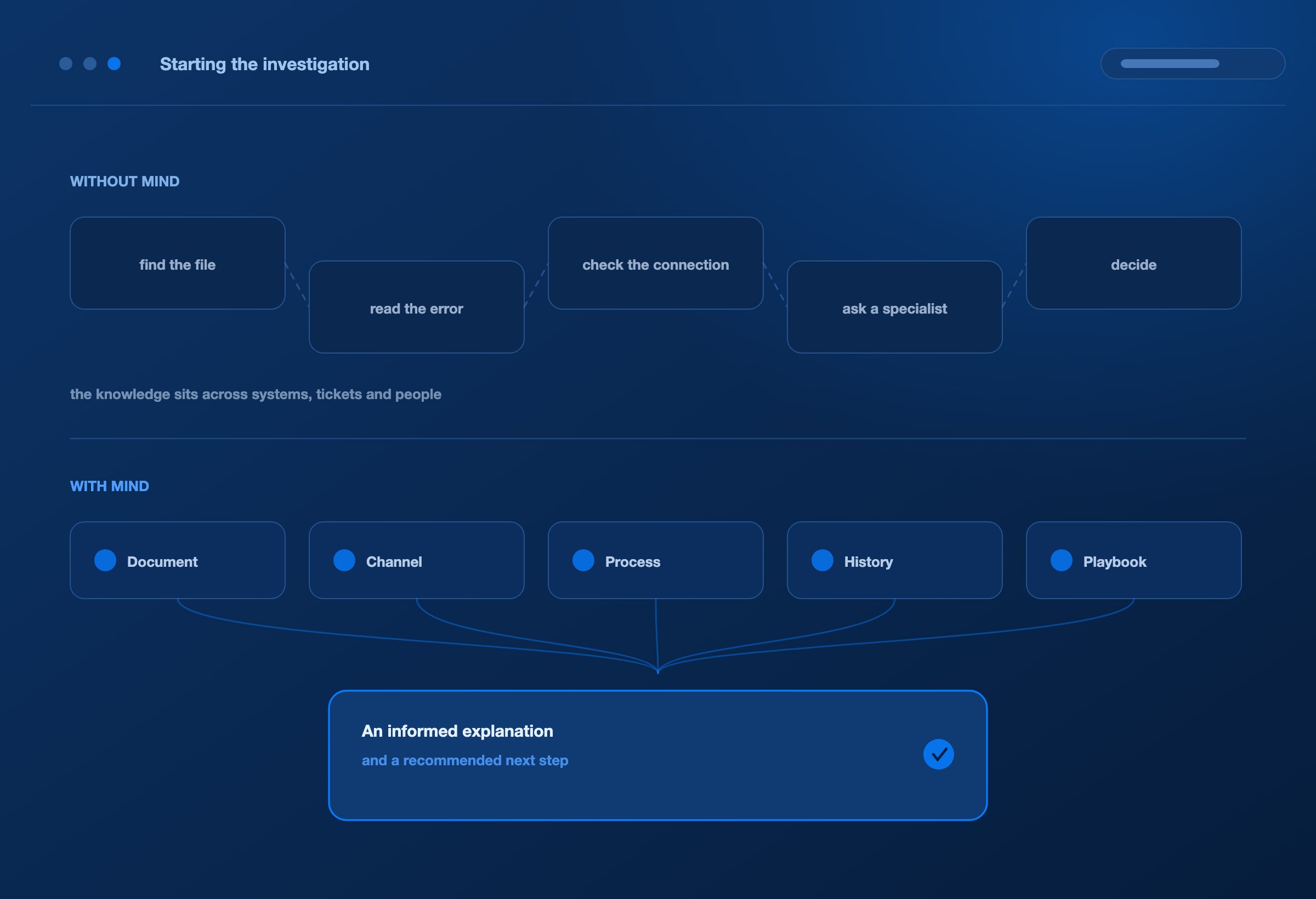
When an integration fails, the investigation often starts with a search: find the file, read the error, check the connection, ask someone who knows the partner, then decide what to do. The knowledge needed to resolve the issue can be isolated across systems, tickets and individual specialists.
DEXA Mind brings that context into the investigation. It gathers relevant evidence from connected DEXA services, consults operational guidance and earlier incidents, and turns the findings into a practical response.
Your team starts with an informed explanation and a recommended next step. That means less time assembling the facts and more capacity to move critical integration work forward.
CONNECTED CONTEXT
Connect the facts across DEXA.
A failure message tells only part of the story. Mind can look across the connected platform to understand the document, the processing path and the surrounding operational conditions.
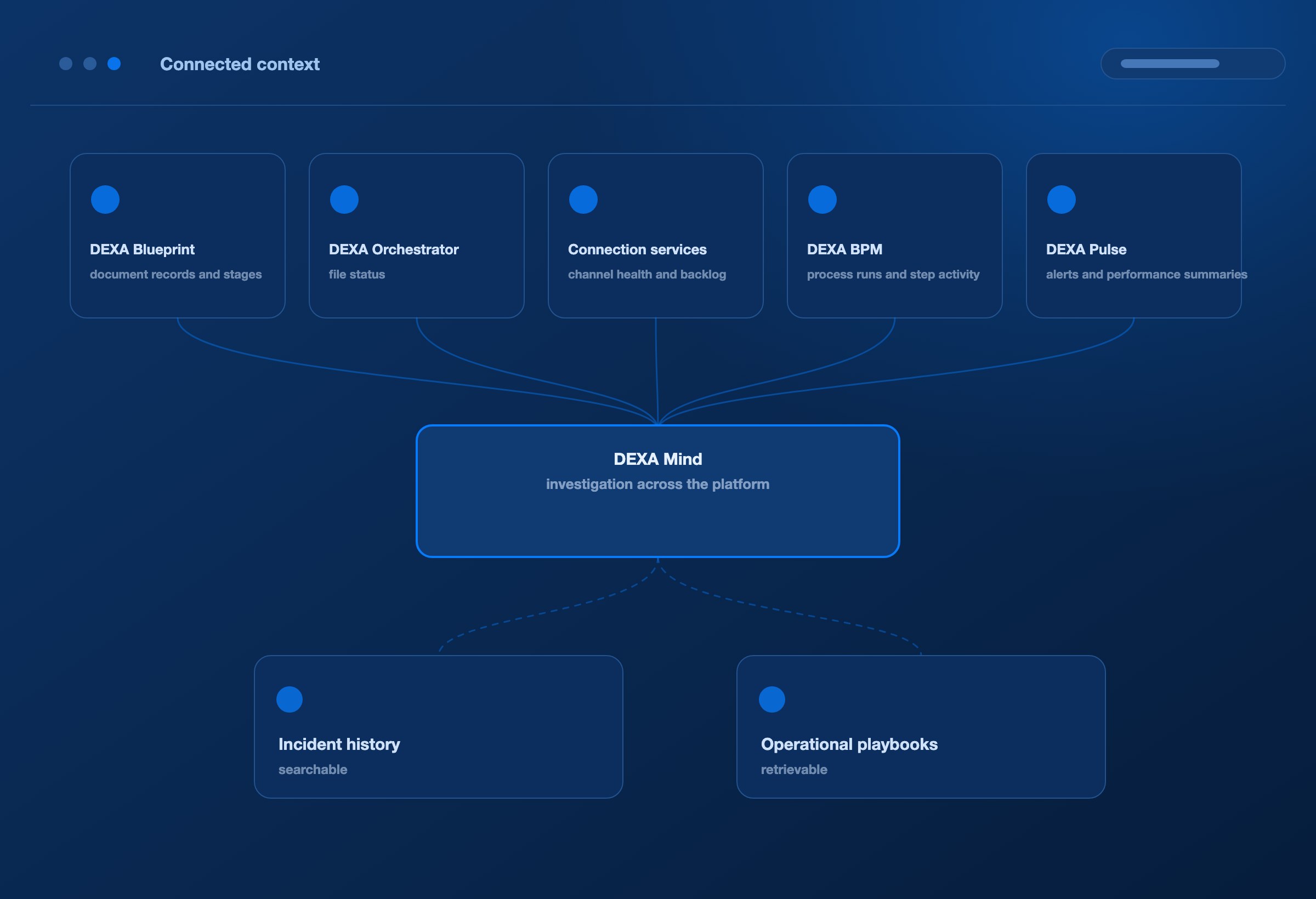
Connected service / Context Mind can use
DEXA Blueprint
Document records and recorded processing stages that help establish the integration journey.
DEXA Orchestrator
File status, partner information, transmission errors and processing evidence.
Connection services
Channel health, backlog measures and file-level processing and delivery reports.
DEXA BPM
Available process-run status, failed runs and recorded step activity.
DEXA Pulse
Operational alerts and performance summaries that help frame the investigation.
Mind combines this evidence with searchable incident history and operational playbooks. Its view follows the services, records and knowledge connected to your deployment.
FIVE STAGES
Give every investigation a practical direction.
Mind connects five stages of operational response.
Recognise the signal. Classify the issue and establish its context.
Gather the evidence. Inspect relevant files, channels, process activity and earlier incidents.
Explain the finding. Summarise what the records show, with supporting references.
Recommend the next action. Identify supported recovery, data correction or specialist investigation.
Move the work forward. Coordinate approved actions and configured communication workflows.
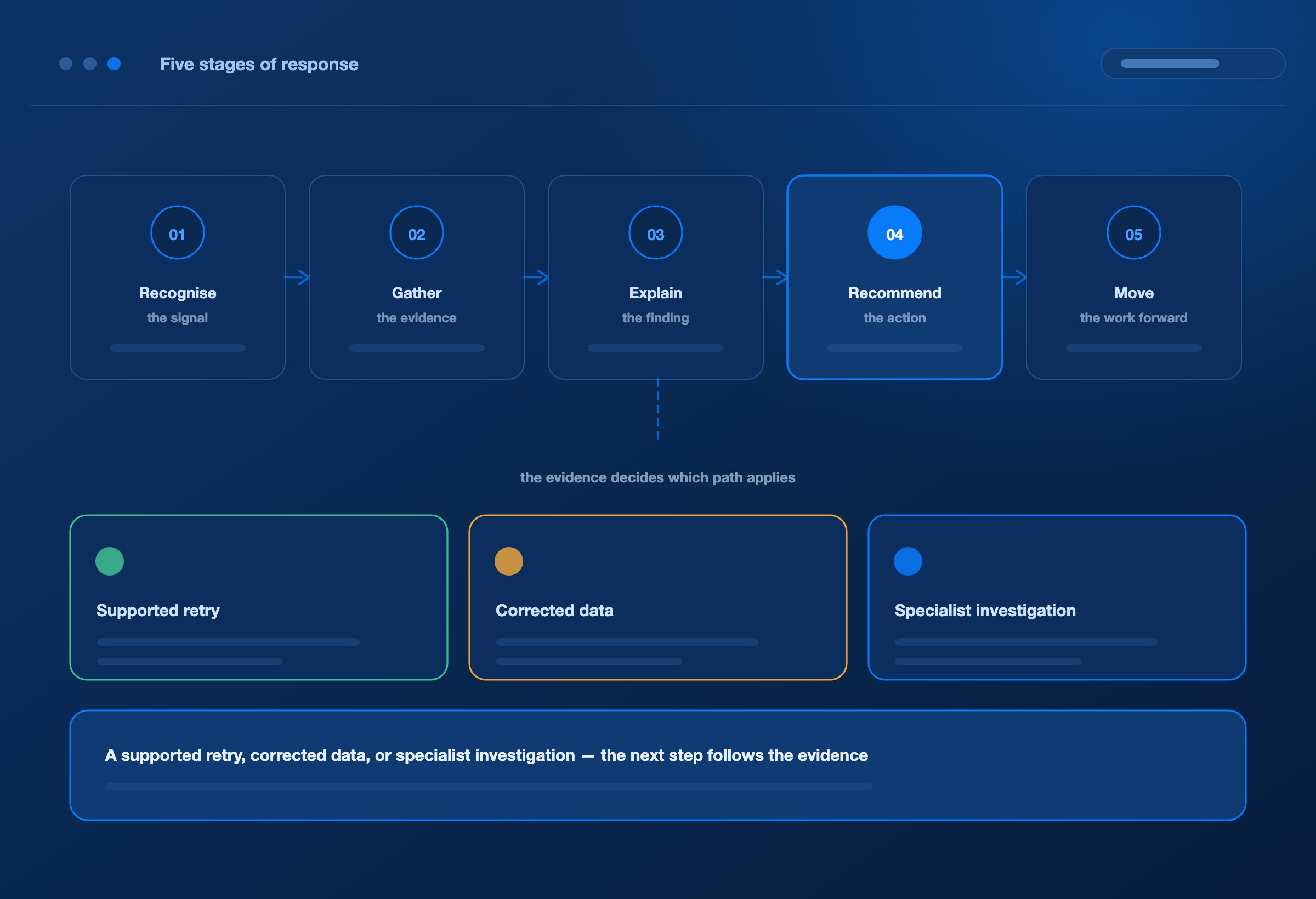
Mind distinguishes between issues that need a supported retry, corrected data or specialist investigation, so the next step follows the evidence.
CAPABILITIES
Intelligence for the work around your integrations.
Mind brings investigation, communication and supported recovery into a connected operational workflow. These capabilities use the systems, records and action controls enabled in your deployment.
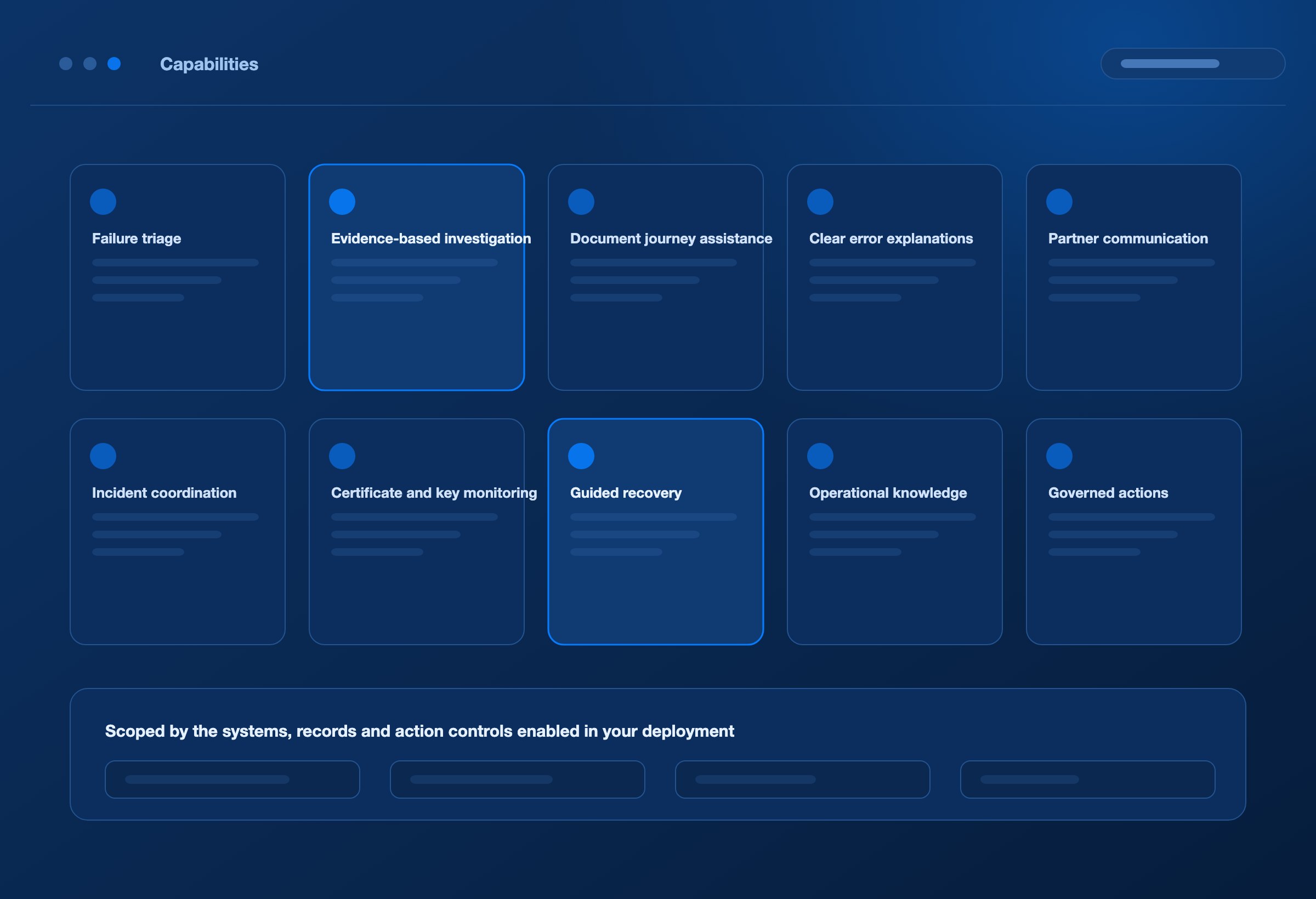
Capability / What it does for your team
Failure triage
Classify incoming issues by error type, partner and severity so investigations begin with relevant context.
Evidence-based investigation
Connect document status, processing reports, channel information, process activity and relevant history to explain what the records show.
Document journey assistance
Answer “Where is my file?” by tracing available processing and delivery information across the connected DEXA platform.
Clear error explanations
Turn technical failures into understandable descriptions of the affected exchange, the reported issue and what needs attention.
Partner communication
Prepare notices explaining the affected document and correction needed. Enabled workflows can send eligible notices to the configured contacts.
Incident coordination
Create support tickets, maintain follow-ups and record replies through configured integrations, keeping the operational context connected to the issue.
Certificate and key monitoring
Identify approaching certificate expiry and SSH key rotation deadlines so teams can arrange the required renewal or update.
Guided recovery
Propose supported file requeue or pending-delivery retry actions, with their rationale and available preview. Approved actions execute through the connected service.
Operational knowledge
Retrieve relevant playbooks and earlier incident information so teams can bring existing knowledge into the current investigation.
Governed actions
Keep supported actions within configured approval and action controls, with records of proposals, decisions and execution results.
ROUND THE CLOCK
Built for round-the-clock operational support.
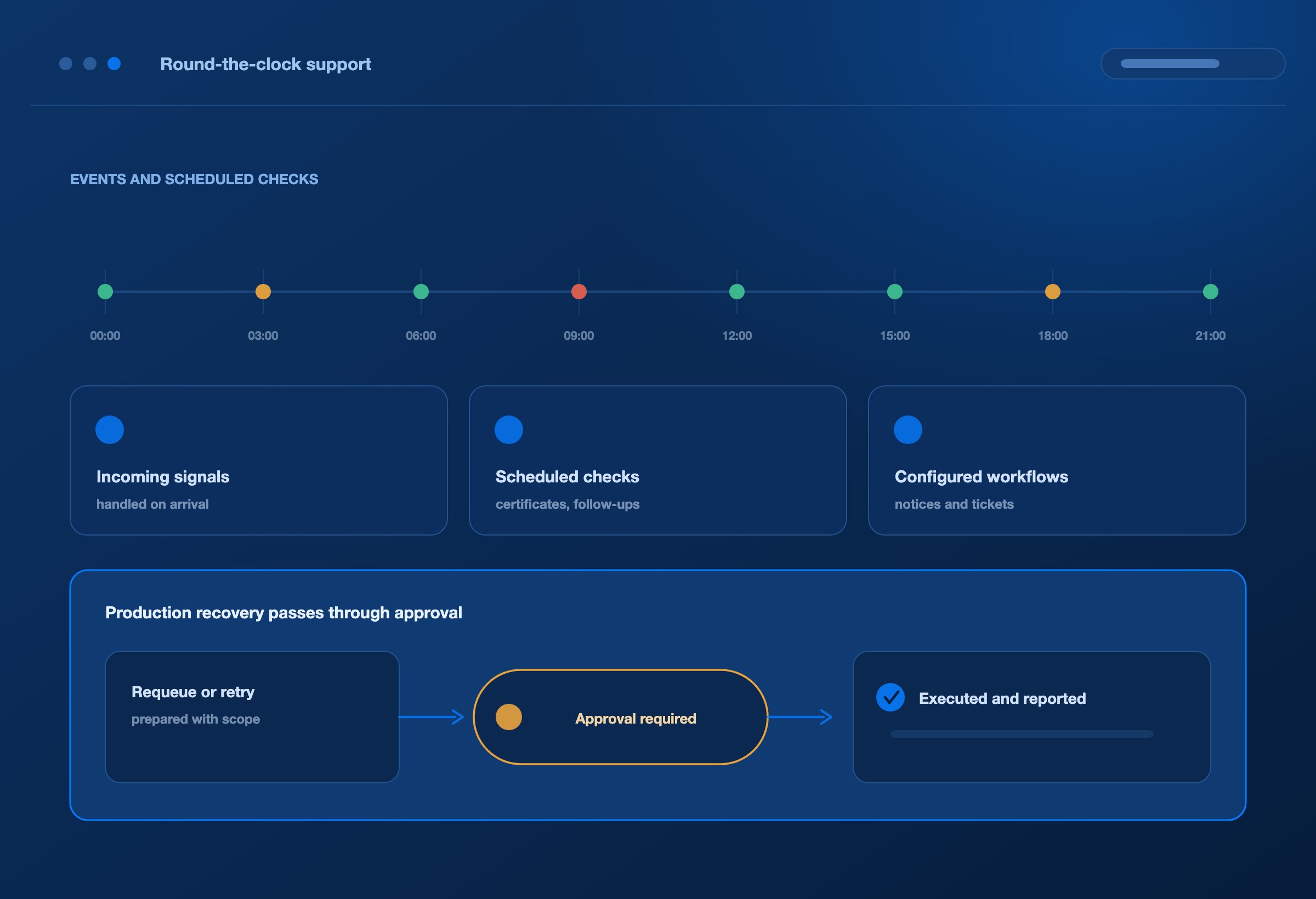
Mind works with incoming operational signals and scheduled checks. It uses evidence from connected DEXA services to support investigation, while configured workflows handle notifications, ticket follow-ups and certificate monitoring. This keeps supported operational work moving beyond the hours when someone is watching a console.
For production recovery, supported requeue and delivery-retry actions currently pass through approval before execution. Data and mapping faults receive an explanation and correction guidance so the right change can be made and tested through the appropriate workflow.
This gives teams a clear way to use autonomy: automate the work Mind is authorised to handle, make recovery actions concrete and reviewable, and bring specialists in with the evidence already prepared.
CONVERSATIONAL WORKSPACE
Ask the operational question. Get the relevant context.
Mind’s conversational workspace lets teams investigate in everyday language. It can call connected tools, retrieve supporting records and explain its findings within the conversation.
“What happened to this file?”
“Why did this partner’s document fail?”
“Have we seen a similar issue for this partner?”
“Which channels are reporting problems?”
“What happened in this process run?”
“Which configured certificates need attention?”
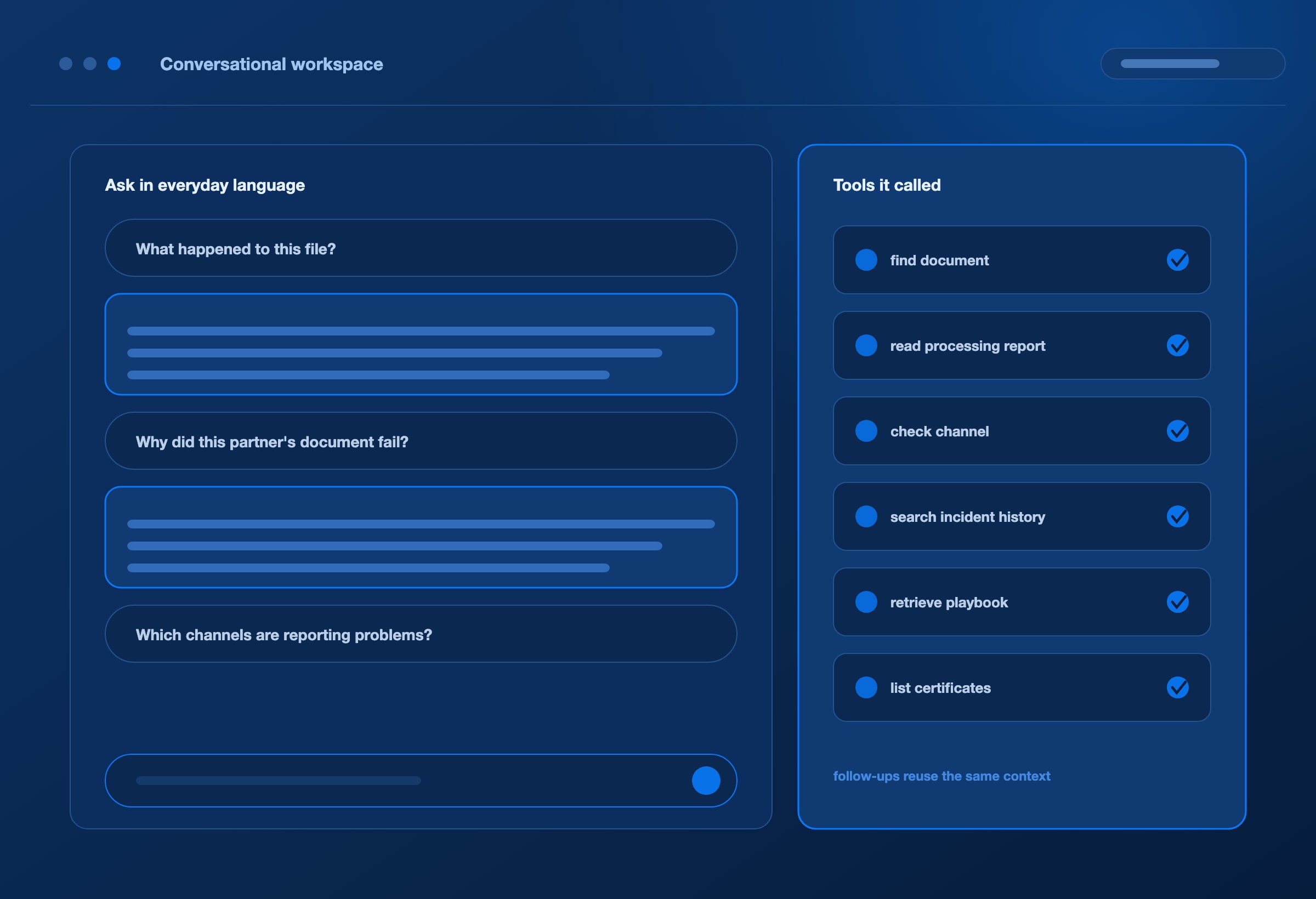
The conversation stays connected to operational evidence. Follow-up questions help the team explore the same issue without repeatedly rebuilding its context.
REUSABLE KNOWLEDGE
Make operational knowledge reusable.
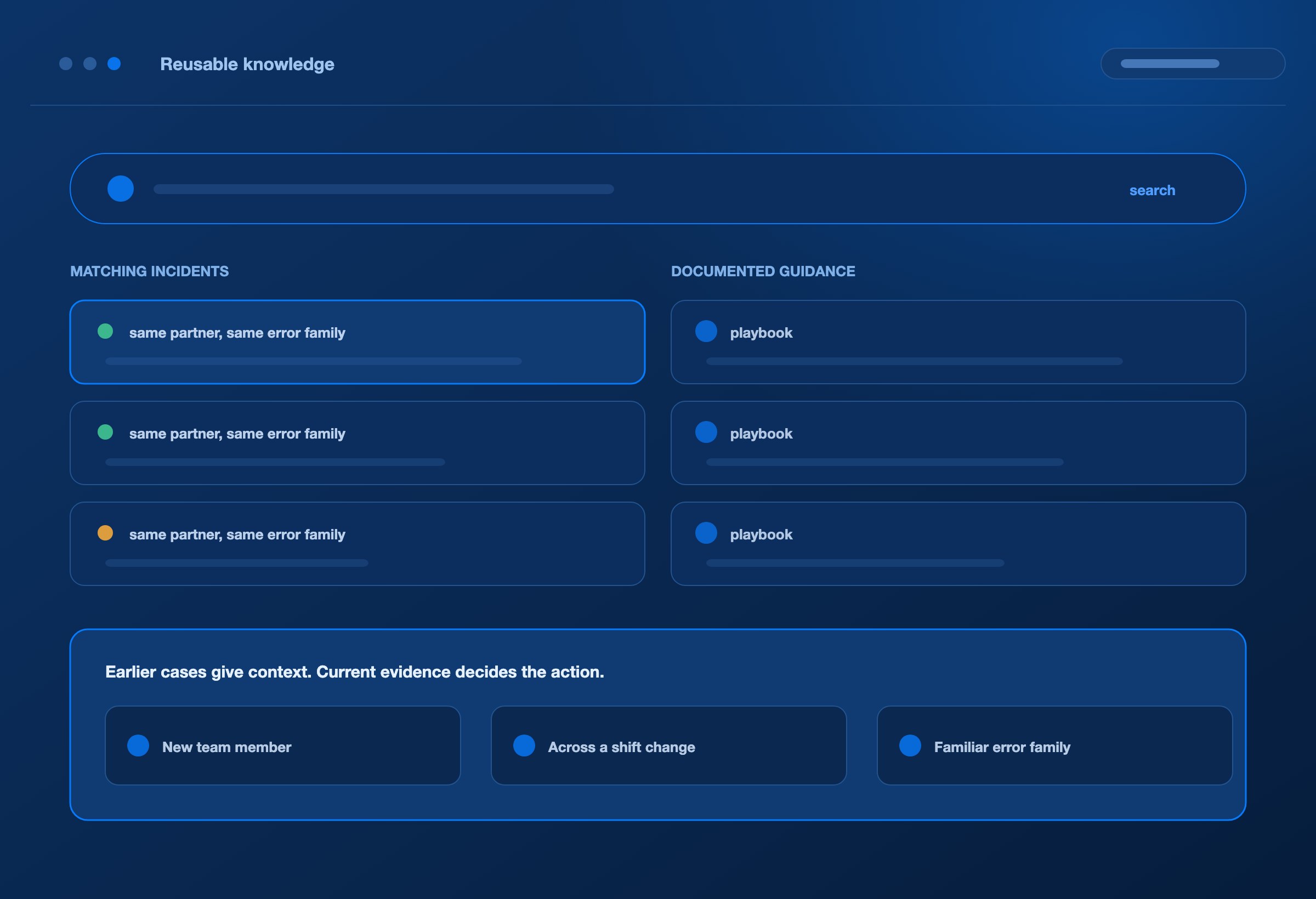
Mind maintains searchable incident context and can retrieve relevant knowledge-base guidance during a new investigation. Familiar error families, partner-specific history and documented procedures become easier to find and apply.
This reduces reliance on whichever specialist happens to remember the previous case. It also gives new team members a more informed starting point and helps carry an investigation across shifts.
Earlier cases provide context for the next diagnosis. The current evidence still determines whether the same action is appropriate.
IN PRACTICE
Recognisable issues. A more informed response.
These illustrative scenarios show how Mind supports the work around integration issues. Available evidence and enabled connections determine what it can investigate and act on.
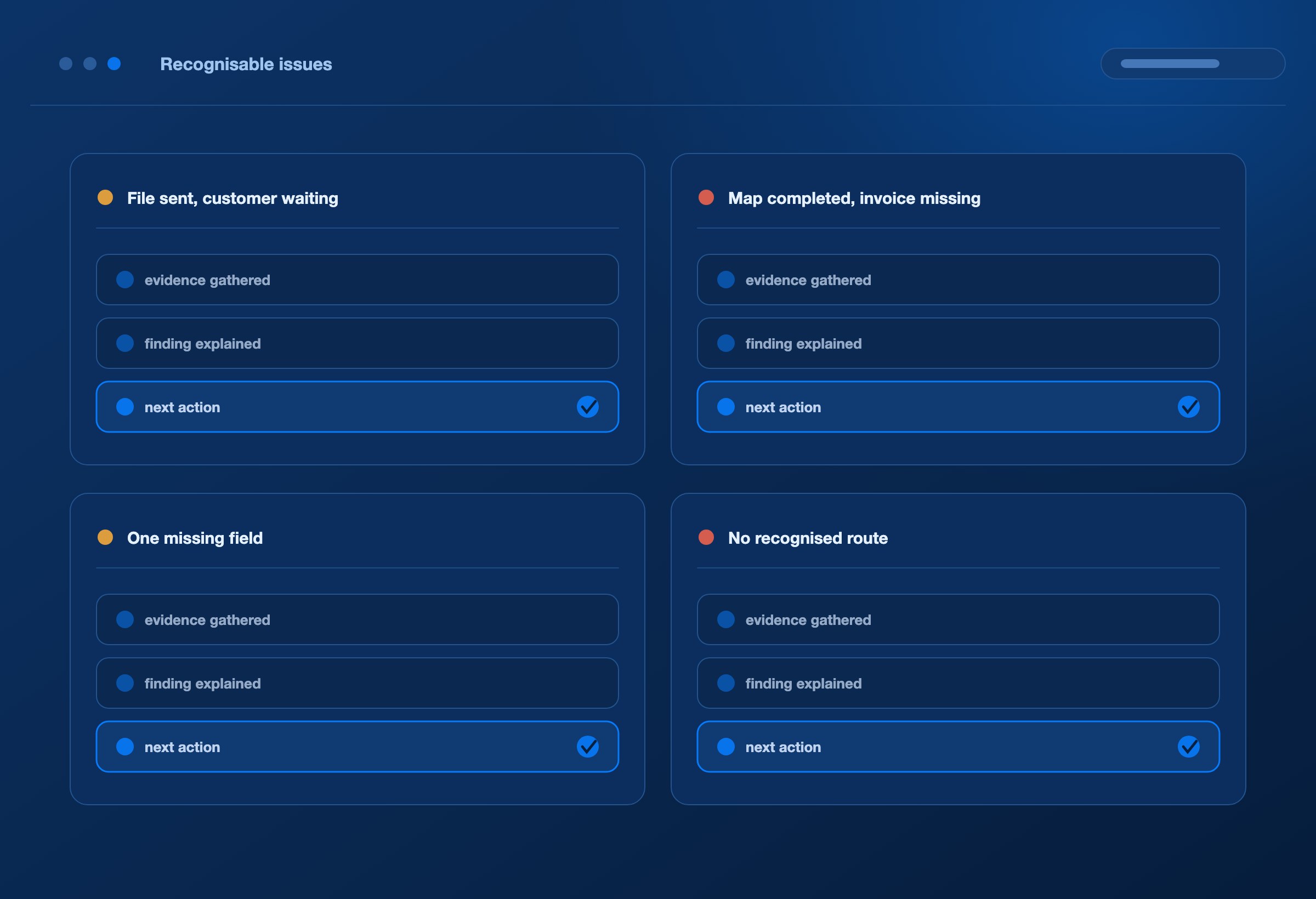
1. The file was sent. The customer is still waiting.
A customer says an expected file has not arrived. Support needs to establish whether DEXA received it, processed it successfully and attempted delivery. Finding the answer can involve several records and teams.
Mind searches the available document journey, processing stages and transmission evidence. It explains what is recorded and where the trail stops, giving support a specific starting point for the next action and the customer update.
Give the customer an answer grounded in the file’s journey.
2. The map completed. The invoice did not arrive.
An invoice passes transformation, but the delivery report shows a connection timeout. The receiving team is still waiting for the exchange needed to continue its billing workflow.
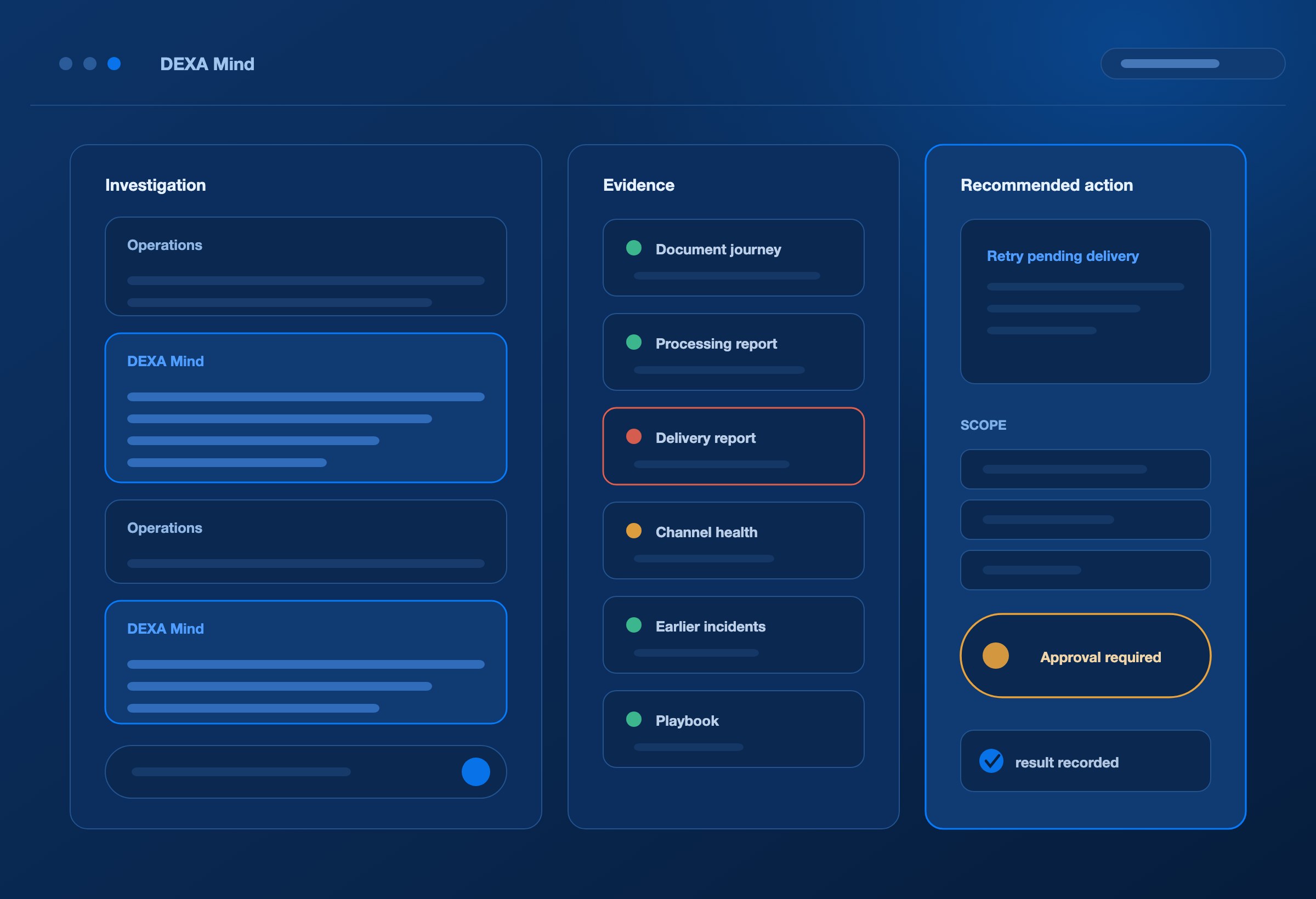
Mind reviews the delivery evidence and channel state. For a supported failure, it can prepare a retry of pending delivery on the identified channel, with its scope and rationale available for review. The connected service executes the action after approval and reports the result.
Move from a delivery failure to a specific recovery action.
3. One missing field holds up the exchange.
A load tender or order fails validation because required information is missing. The support team must identify the issue and explain what the sender needs to correct.
Mind uses the reported error and available file context to explain the failure. Configured workflows can prepare a clear correction notice, create a support ticket and maintain follow-ups. The partner receives a practical request linked to the affected exchange.
Make the correction request easier to understand and act on.
4. A file arrives without a recognised route.
A document cannot be matched to the expected transaction setup and is held for investigation. The cause could involve the file structure, identifiers or an incomplete configuration; the team needs evidence before changing anything.
Mind handles the configured unidentified-document event and can notify the relevant contacts with the file reference, reported reason and supplied attachment. Support begins with the affected document and its context available for review.
Bring an unrecognised document to attention with useful context.
RECOVERY AND COMMUNICATION
Keep the recovery and communication moving.
5. The same partner. The same error. Another investigation.
A familiar validation or processing error appears again. The person who investigated the previous incident may be unavailable, and the earlier explanation may be buried in a ticket.
Mind searches incident history and relevant operational guidance, including partner context where available. It brings earlier diagnoses into the current investigation so the team can check whether the same cause applies and identify the correction that deserves attention.
Make previous investigation work useful again.
6. A correction request should not become a chasing exercise.
The partner has been asked to correct a file. Support must remember the follow-up, maintain the ticket and keep track of any response. Across many open exchanges, that administration becomes substantial work.
With the relevant integrations enabled, Mind schedules follow-ups, records communication in the support workflow and handles matching replies according to configured rules. Teams retain the correspondence needed to decide the next step and check the processing outcome.
Keep the conversation moving without rebuilding its history.
7. Several failures may share one cause.
A group of files reports delivery problems close together. Investigating each file separately can repeat the same checks while a shared channel problem remains unresolved.
Mind can review recent errors alongside channel health, backlog measures and file-level reports. The combined evidence helps the team assess whether the failures share a dependency or require separate investigation. Any recovery proposal is reviewed for its intended scope.
Understand the common context before repeating the work.
8. Check the journey before sending the file again.
A partner requests a resend because a document cannot be found in its application. Support needs to understand the recorded processing and delivery history before deciding whether another send is appropriate.
Mind retrieves the available journey and explains what the records show. The team can use that evidence to check whether the next investigation belongs with delivery or the receiving application, and decide whether a resend is needed.
Give the resend decision an evidence-based starting point.
KNOWLEDGE AND FORESIGHT
Bring knowledge and foresight into daily operations.
9. The process stopped after the document was mapped.
Transformation completes, but a later step in the connected business process reports a failure. The next question is which activity needs attention and which service owns it.
Mind retrieves available process-run and step records and relates them to the document journey. It helps the team identify the last completed activity, inspect the reported failure and direct the investigation to the relevant process step or connected service.
Follow the work beyond the map.
10. A certificate is approaching expiry while traffic still flows.
An integration may continue working while a configured certificate is nearing expiry or an SSH key is due for rotation. The operational task is to arrange the update before it becomes urgent.
Mind’s configured checks inventory the relevant certificates and keys, assess expiry or rotation status and surface findings for review. Teams can identify what needs attention and organise the renewal or replacement with the responsible owner.
Make time-sensitive maintenance visible while there is time to act.
11. The next shift needs the context, too.
An incident remains open when ownership changes. The incoming colleague needs to know what failed, what has been checked and why a particular action was proposed.
Mind’s searchable incident context, recorded activity and conversational investigation help the next person retrieve relevant evidence and earlier findings. Operational knowledge becomes available beyond the person who first handled the issue.
Carry understanding across shifts and team changes.
12. A new failure needs a well-prepared specialist.
An unfamiliar issue does not match a known recovery path. Resolving it may require a developer, application owner or partner specialist to examine the facts.
Mind can gather the available file, channel and process evidence, consult operational guidance and explain the current findings. The specialist receives a more useful starting point for investigation, with the relevant references and unresolved questions in view.
Use expert time on the problem that needs expertise.
AN ILLUSTRATIVE EXCHANGE
See the conversation move from status to action.
The following illustrative conversation uses a delivery-timeout scenario in which the connected records confirm the findings.
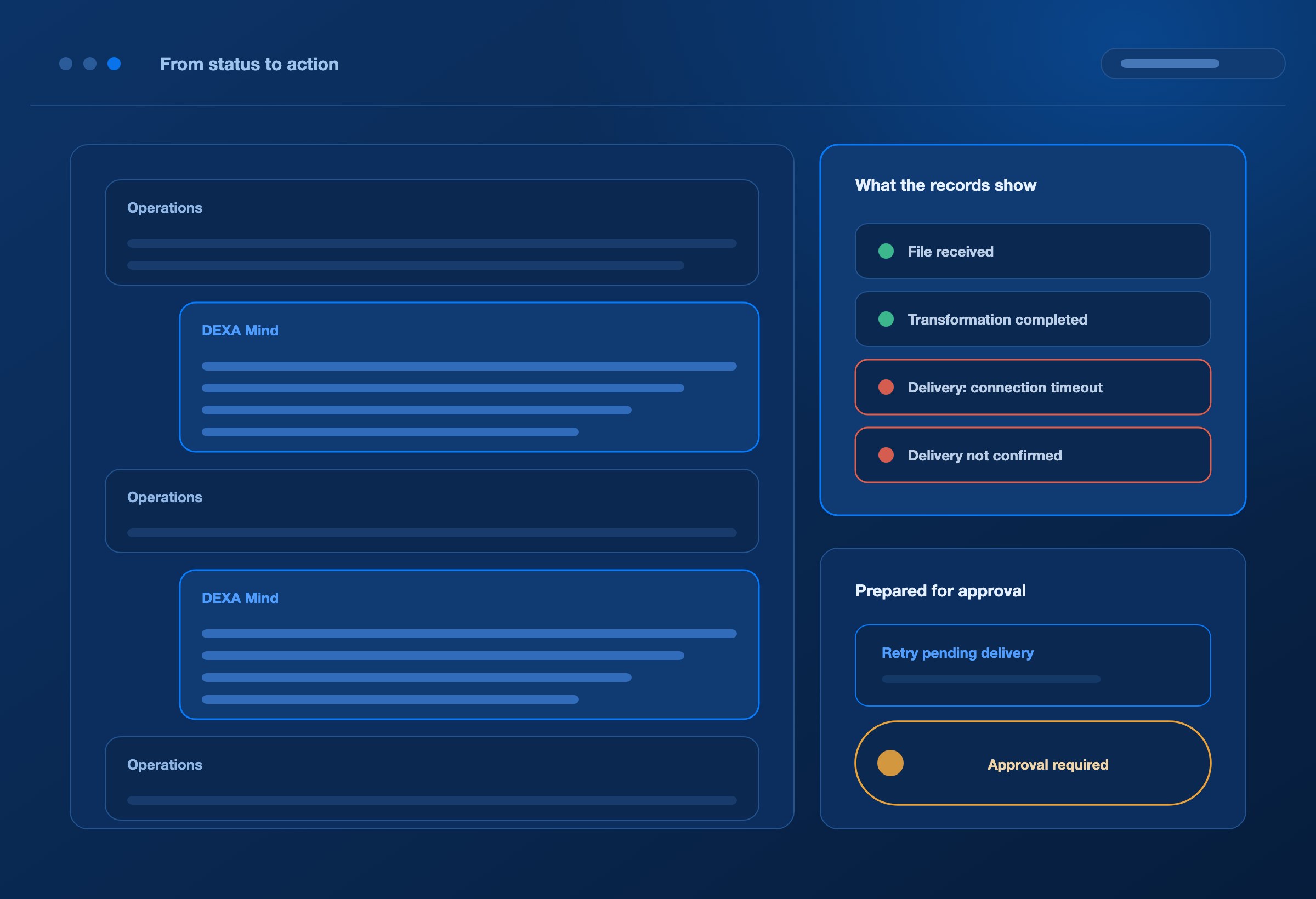
Operations: “The customer says this invoice has not arrived. What happened?”
DEXA Mind: “The available records show that the file was received and transformation completed. The delivery report records a connection timeout. That report does not confirm successful delivery.”
Operations: “What should we do next?”
DEXA Mind: “Check the current channel status and review the pending delivery items. A supported delivery-retry proposal can then be prepared for approval, with the affected channel and action scope shown.”
Operations: “Have we seen a similar failure for this partner?”
Mind can search the stored incident history and operational guidance, bring relevant matches into the conversation and help the team compare them with the current evidence.
The practical value is continuity: the file status, the reported failure, the recovery option and the earlier context stay part of the same investigation.
A stronger first response changes the work that follows.
An operational response becomes more useful when it identifies the affected exchange, explains the recorded issue and states the next step. Mind helps teams bring those elements together using the available evidence.
For the customer, that means a clearer update. For support, it means less time reconstructing the case. For the specialist, it means a better-prepared investigation. For the business, it means a more informed response to an integration issue that may be delaying a customer or partner workflow.
GROWING THE NETWORK
Your partner network can grow without repeating every support task.
Adding partners creates more exchanges to monitor, more operating questions to answer and more requirements to remember. The support workload includes far more than the moment a file fails.
Mind takes on repeatable investigation and coordination activities so the team can use its capacity on work that requires deeper judgement. The opportunity is to reduce the effort attached to each issue as the network grows.
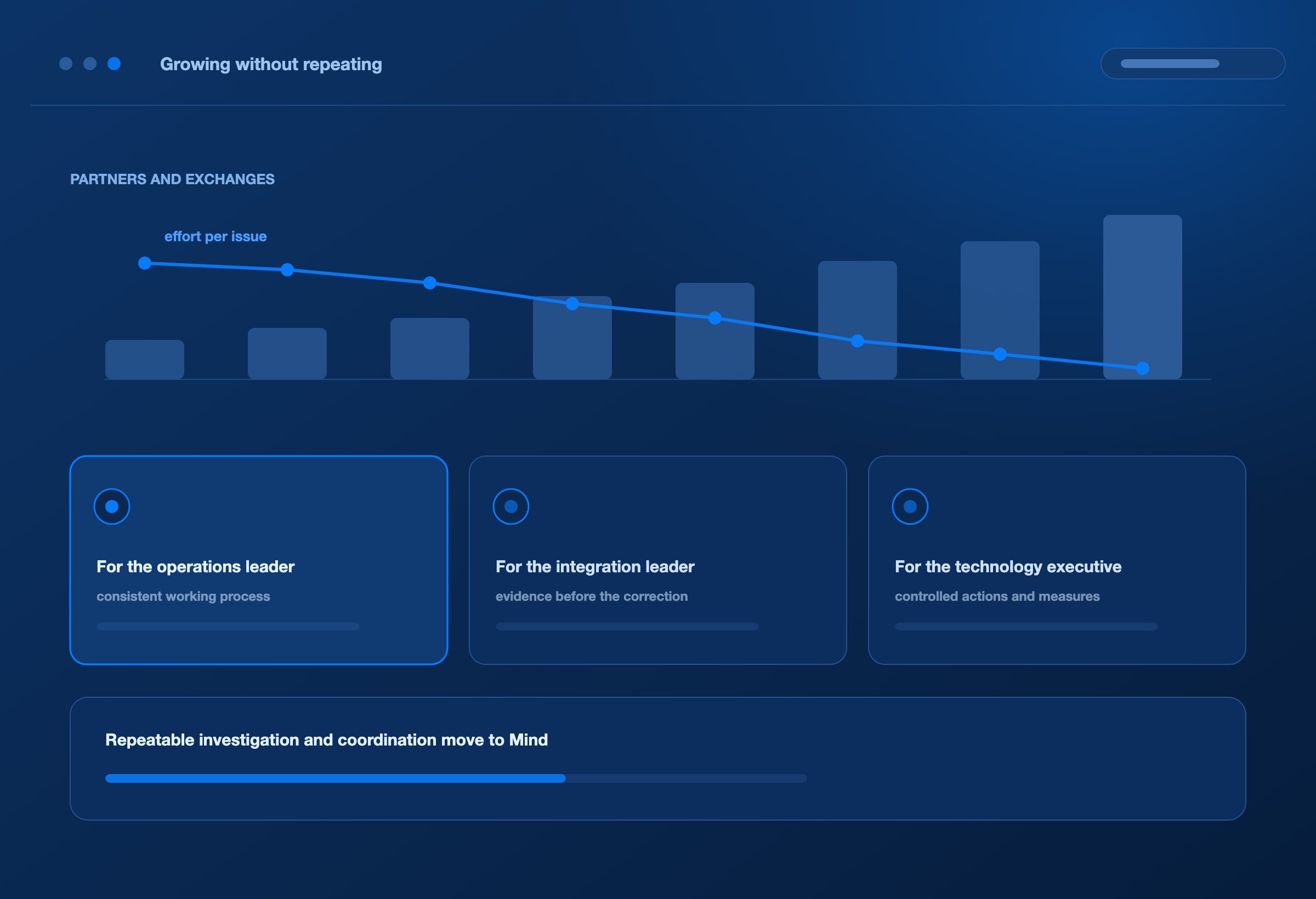
For the operations leader
Bring file status, incident context and next actions into a more consistent working process. Reduce time spent asking other teams to reconstruct an exchange.
For the integration leader
Give analysts and developers the relevant evidence before they begin a correction. Use recurring incident context to decide which requirement, source-data or mapping issue deserves a lasting fix.
For the technology executive
Evaluate where AI reduces repetitive support work, how actions remain controlled and which measures demonstrate value. Connect the investment to operating capacity and cost per incident.
EVALUATION
Measure the work Mind takes off the team's hands.
Use a representative set of your own incidents to compare the effort before and after introducing Mind. Separate time spent gathering evidence, diagnosing the issue, communicating and performing recovery so the source of any improvement is visible.
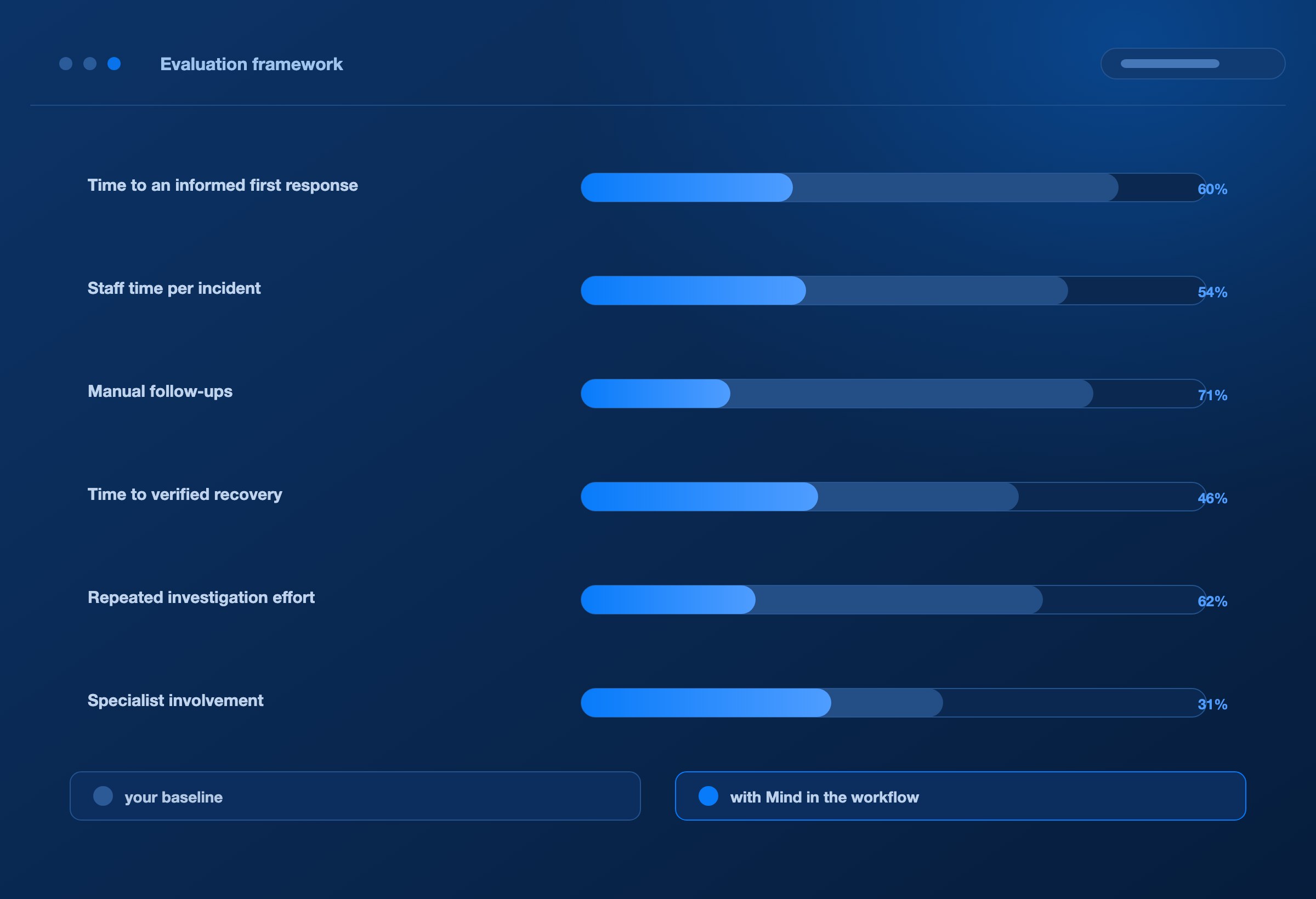
Measure / What it tells you
Time to an informed first response
How quickly the team can explain the issue and identify a useful next step.
Staff time per incident
How much manual work remains across investigation, communication and coordination.
Manual follow-ups
How much communication administration the configured workflows handle.
Time to verified recovery
How long it takes to confirm the intended processing or delivery outcome.
Repeated investigation effort
Whether earlier incident knowledge is reducing work on familiar issues.
Specialist involvement
Which issues still need deeper expertise and whether those escalations arrive with useful evidence.
Use this evaluation framework in your deployment to connect AI activity to measurable changes in operational effort and service performance.
GOVERNANCE
Keep intelligence accountable.
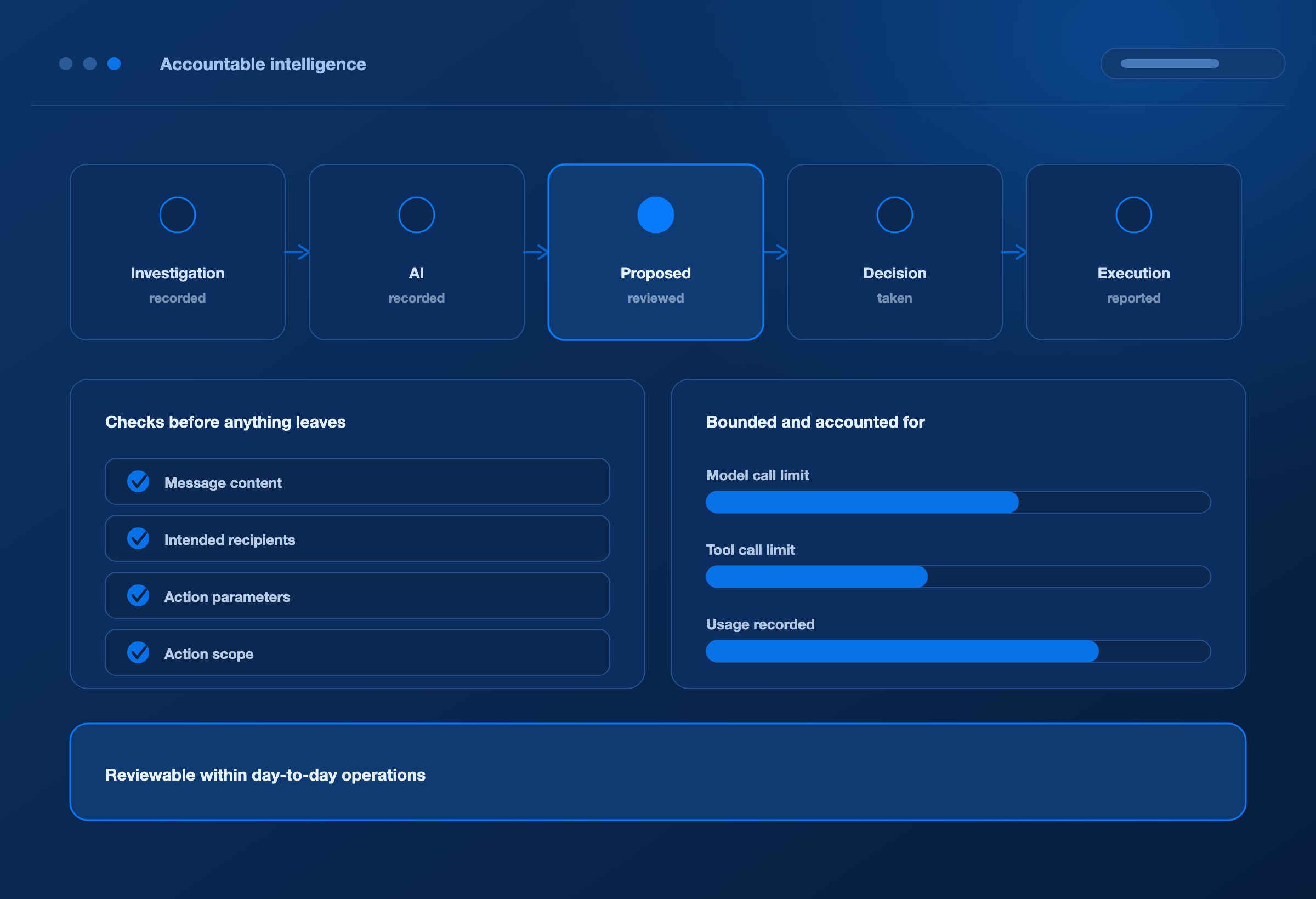
Mind records available investigation context, AI activity, proposed actions and execution results. Teams can review what was recommended, the decision taken and the outcome reported by the connected service.
Checks on supported outbound messages and recovery proposals examine their content, intended recipients, action parameters and scope. Model and tool-call limits bound individual investigations, while usage records help teams understand the cost of AI activity.
These controls make Mind’s work reviewable within day-to-day operations.
ONE PLATFORM
Intelligence that complements every part of DEXA.
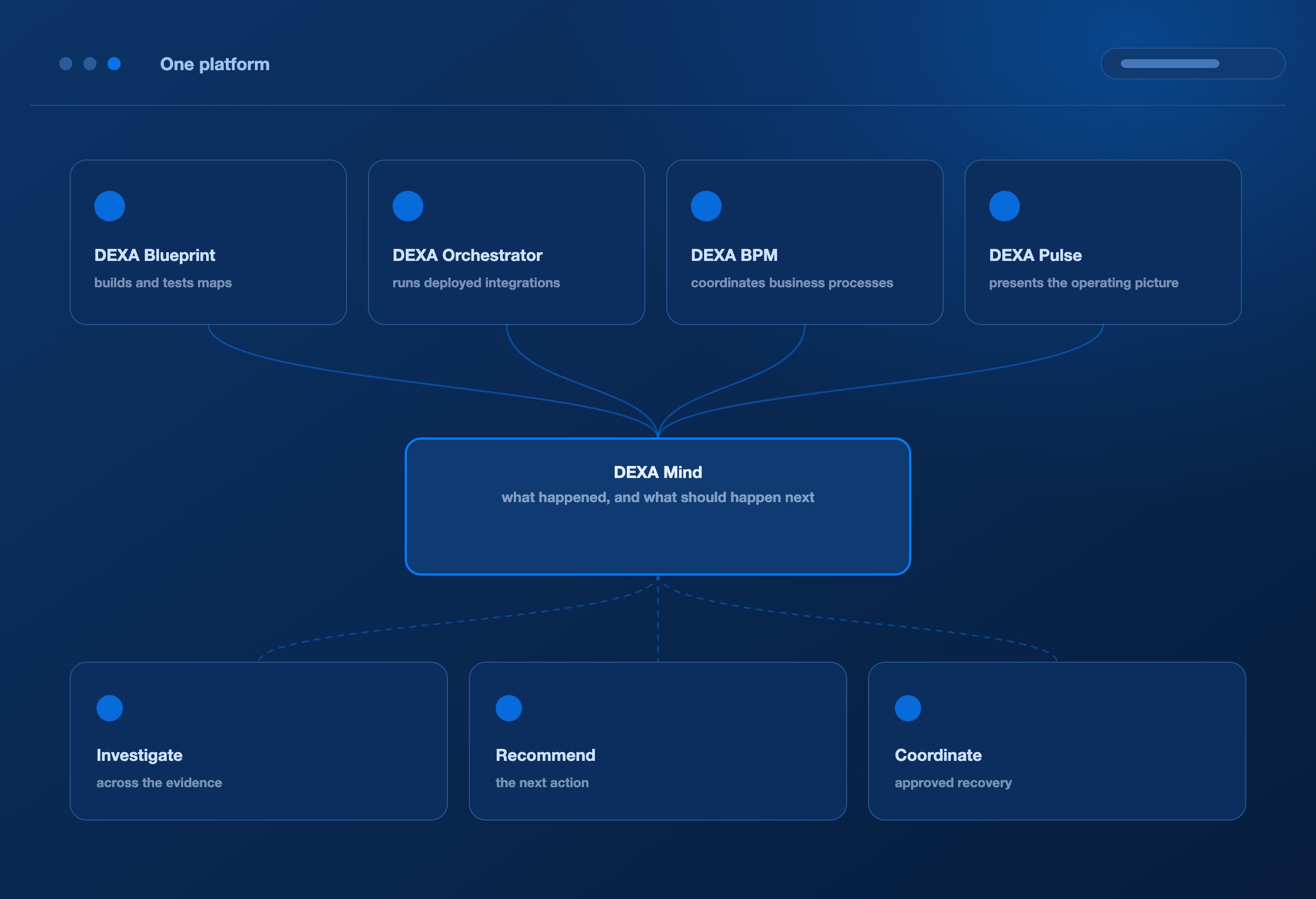
Blueprint remains the design studio where AI agents build and test maps. Orchestrator runs the deployed integrations. BPM coordinates business processes, and Pulse presents the operating picture.
Mind uses the available context across these services to investigate what happened and recommend what should happen next. Together, they connect integration execution with the intelligence and support activity needed to keep operations moving.
FAQ
Frequently asked questions
Can DEXA Mind resolve issues automatically?
Mind automates supported investigation and configured communication workflows. It also prepares and executes approved requeue and delivery-retry actions. A data, mapping or business-rule problem follows the relevant correction and testing workflow.
Does Mind understand everything across the enterprise?
Mind works with the systems, operational records and knowledge connected to it. Additional applications and information sources require the appropriate integration and access configuration.
Does Mind learn from earlier incidents?
Mind stores incident context and retrieves similar cases and documented guidance for later investigations. This makes earlier knowledge reusable; each new recommendation is assessed against the current evidence.
Does Mind generate and run EDI maps?
AI agents in DEXA Blueprint generate and test maps. DEXA Orchestrator runs deployed maps. Mind provides operational investigation, recommendations and supported recovery coordination around those integrations.
Can Mind support operations around the clock?
Configured event processing, background checks and scheduled follow-ups continue while the services are running. The work handled automatically depends on the enabled connections, workflows and action controls.
NEXT STEP
Understand the issue. Move the next action forward.
Bring an operational question to the conversation. See how Mind finds the relevant evidence, explains the issue and supports the next action. Explore where AI agents can reduce repeated work and give your team more capacity to support customers and partners.
